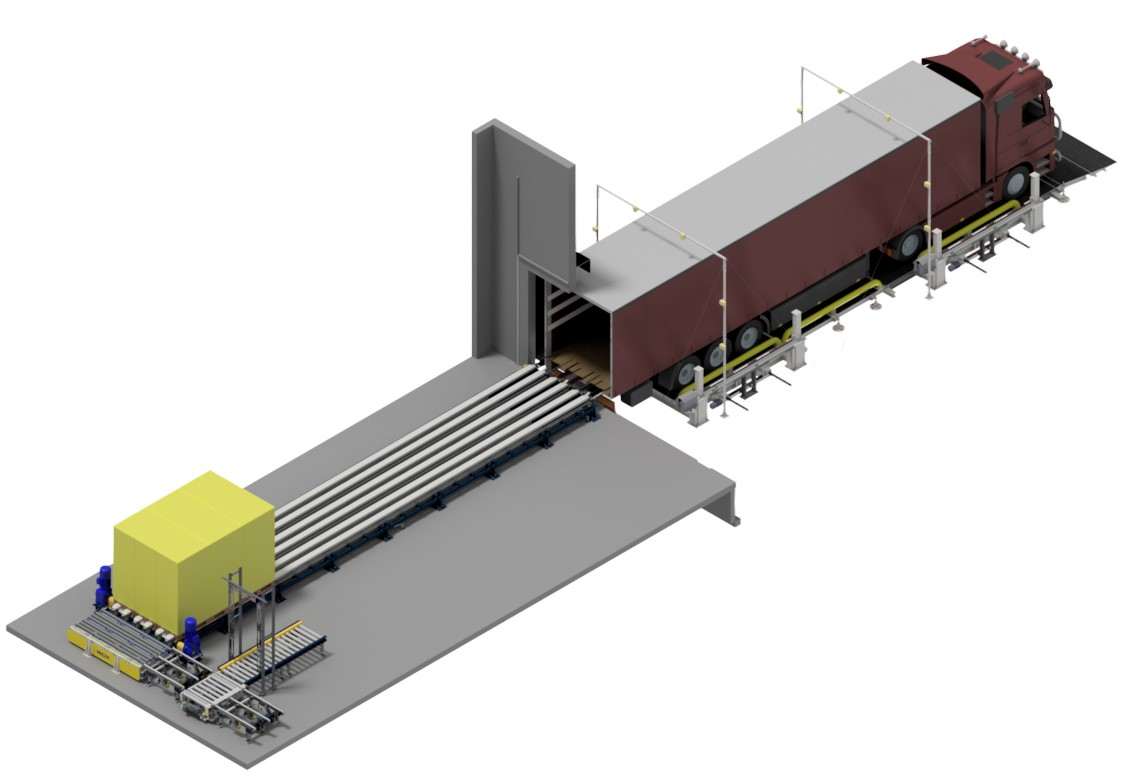
Load and unload a full trailer.In under five minutes.
A complete trailer cycle in five to seven minutes of machine time, on standard unmodified trailers. Engineered per site, certified to CE, and controlled to the millimetre.
We're bringing WDX Group's automated truck loading and unloading system to the United States.
You do not need to
rebuild your trailers.
A full trailer in five to seven minutes, at 4.65 truckloads per hour.
Watch a full trailer cycle, start to finish.
Benefits of Q-Loader
No trailer modification required
Works with any standard, unmodified truck and any pallet type. No rebuild, no retrofit, no disruption to your existing fleet.
A full trailer in five to seven minutes
Machine cycle of 5 to 7 minutes per trailer on the US configuration. At 4.65 truckloads per hour per dock, one Q-Loader replaces several manual dock operations.
Up to five times fewer docks
The throughput gain means fewer dock doors are needed for the same outbound volume, which shrinks the facility footprint.
Reduces labour dependency
Once the system is staged and the trailer docked, loading is fully automated. Labour is redeployed to higher-value tasks inside the facility.
CE-certified, engineered per site
Every installation is designed around your trailer types, pallet configuration and operational cadence. Certified to CE standard throughout.
Payback inside 24 months
In high-throughput operations, our clients consistently achieve return on investment within 12 to 24 months of installation.
Fork or chain skate, specified to your load.
Both platforms share the same truck positioning system, loading bridge architecture, galvanised construction and SEW/Siemens drive specification. Platform type is selected in the detailed design phase to match pallet type, orientation and load weight, and where the SKU profile calls for it, we engineer custom containers and totes to match.
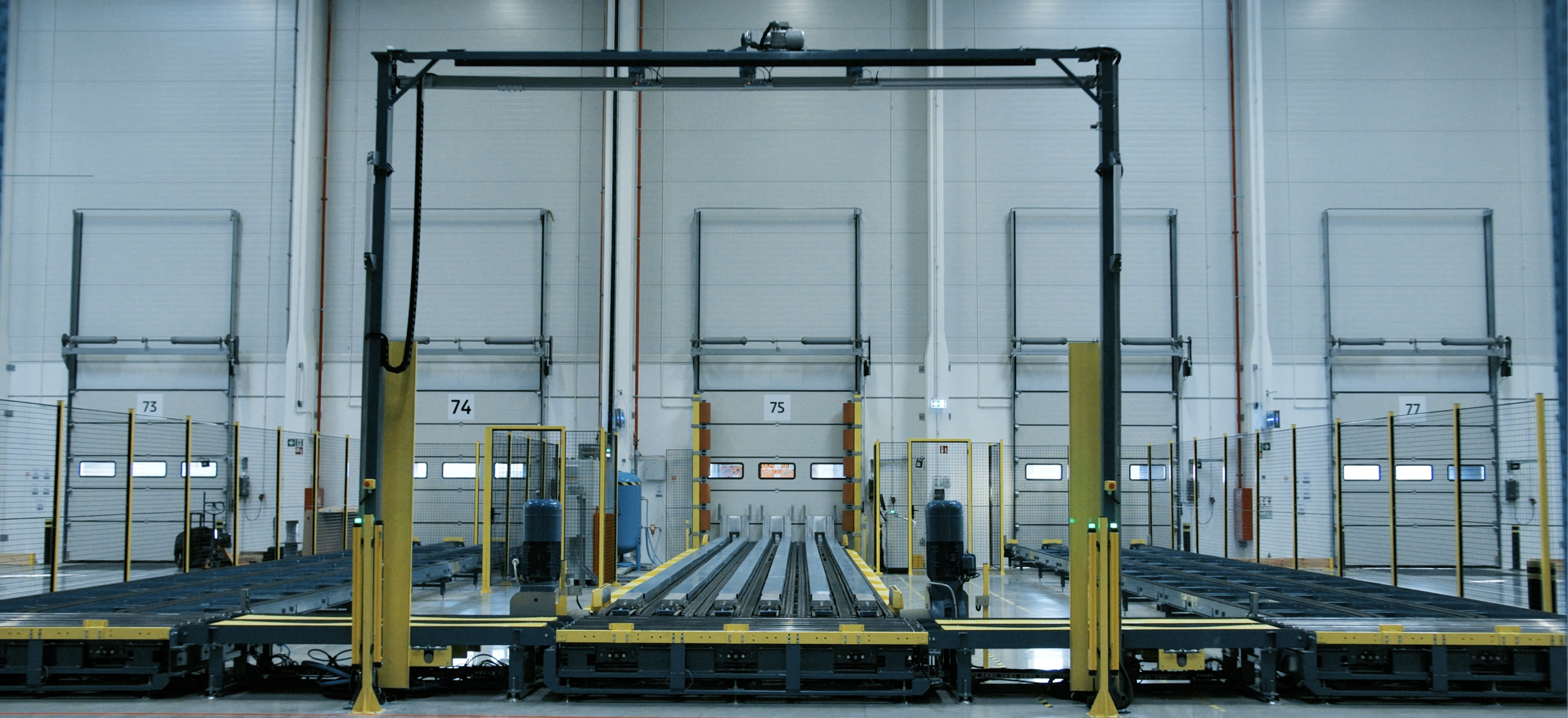
- Load cycle
- Approx. 5–7 min machine time
- Pallet lifting
- 1–2 min depending on pallet weight
- Max load capacity
- 24 t (52,900 lb), 1,200 kg/m²
- Length × Width
- 618.11 in × 147.64 in
- Transport height
- 27.56 in
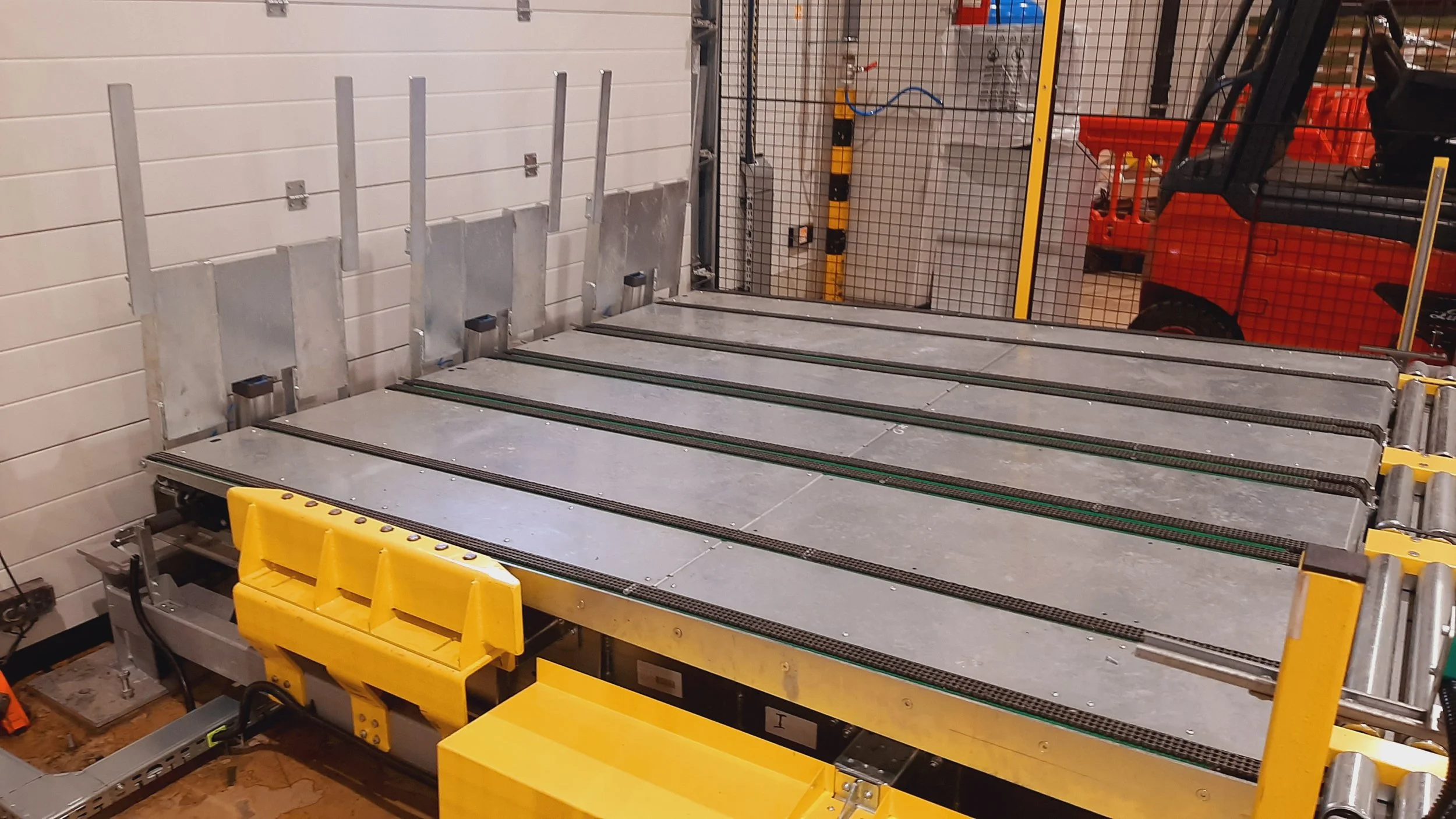
- Forks
- 4 forks at 594.50 in, steel rollers, pneumatic lifting
- Pallet type
- GMA broadside loaded: floor-level access with internal stability
- Air consumption
- 3–4 bar, approx. 360 L per cycle
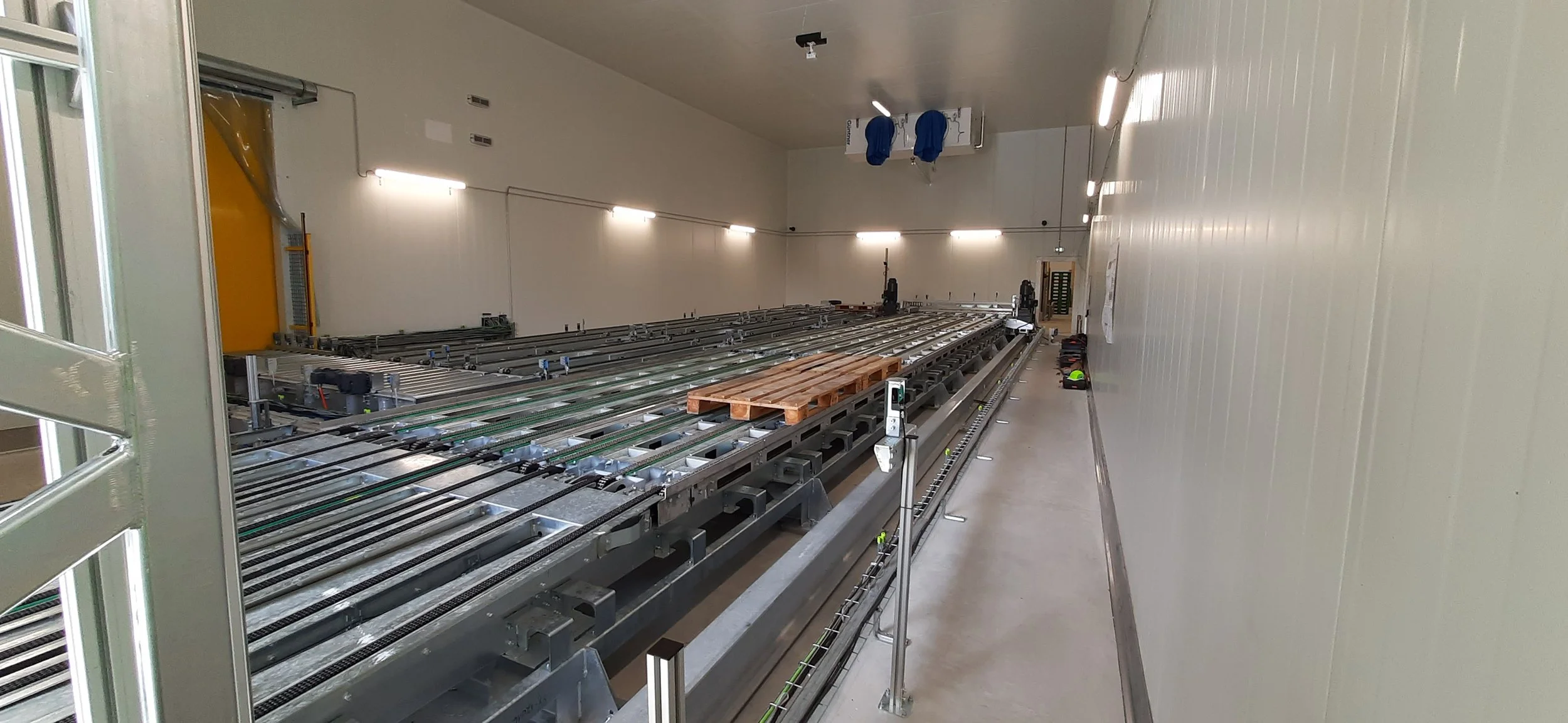
- Load cycle
- Approx. 10 min machine time
- Max load capacity
- 24 t (52,900 lb), 1,200 kg/m²
- Length × Width
- 669.3 in × 147.64 in
- Transport height
- 33.46 in
- Chain conveyor platform
- 633.86 in, steel rollers 1.70–2.36 in diameter
- Front wedge decline
- Approx. 2.2 degrees
- Pallet types & orientation
- Specified by the customer
- Platform height note
- Approx. 150 mm platform height reduces free trailer height.Trailer free height must exceed pallet height by at least 200 mm.
- Loading bridges
- 3 flaps: pneumatic or electrical drive, automatic trailer floor height recognition
- Construction
- Galvanised or powder-coated loading platform
- Gearbox drives
- SEW / Siemens
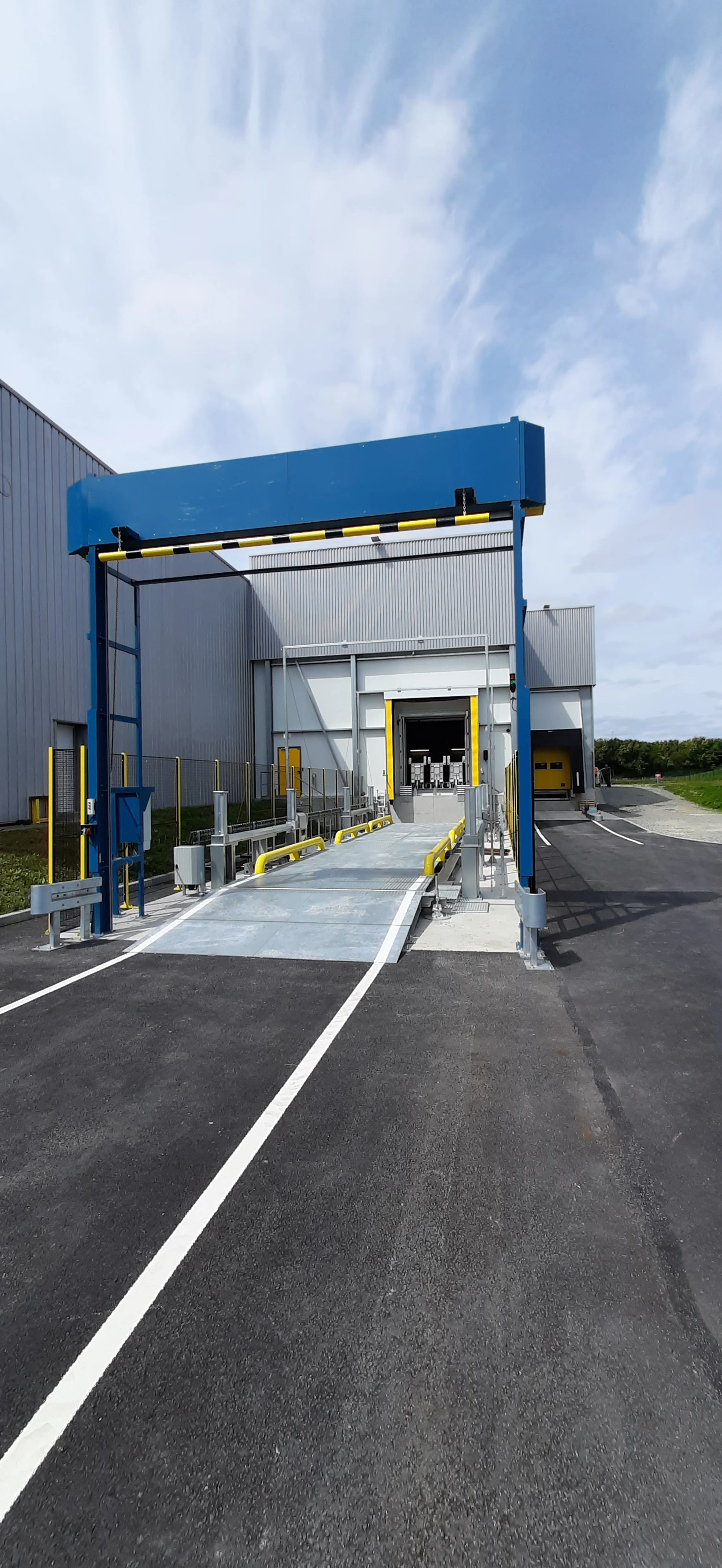
The trailer is measured, then moved to meet the machine.
The truck parks on the loading ramp. Loading bridges lower automatically onto the trailer floor. The entire truck is then measured and aligned in XYZ via lifting table, and trailer height is measured and corrected continuously throughout the entire load cycle.
Two trailer contour check gates with ultrasonic sensors verify the trailer interior before any pallet moves.
- Ramp length
- 75 ftAccommodates most US cab lengths, trailer lifts only.
- Width
- Approx. 200 in
- Max load capacity
- 92,600 lbs
- Height correction
- ±5 in
- Width correction
- ±14 in
- Truck positioning time
- Approx. 1–2 min
- Contour check gates
- 2 gates with ultrasonic sensors
A scanner gate measures the trailer interior, recognises obstacles and verifies interior dimensions, before a single pallet moves.
Trailer irregularities, obstacles and non-conforming interior dimensions are detected at the gate stage. The system will not proceed until the interior is verified clear, protecting both the load and the equipment.
A conveyor line built around your dock.
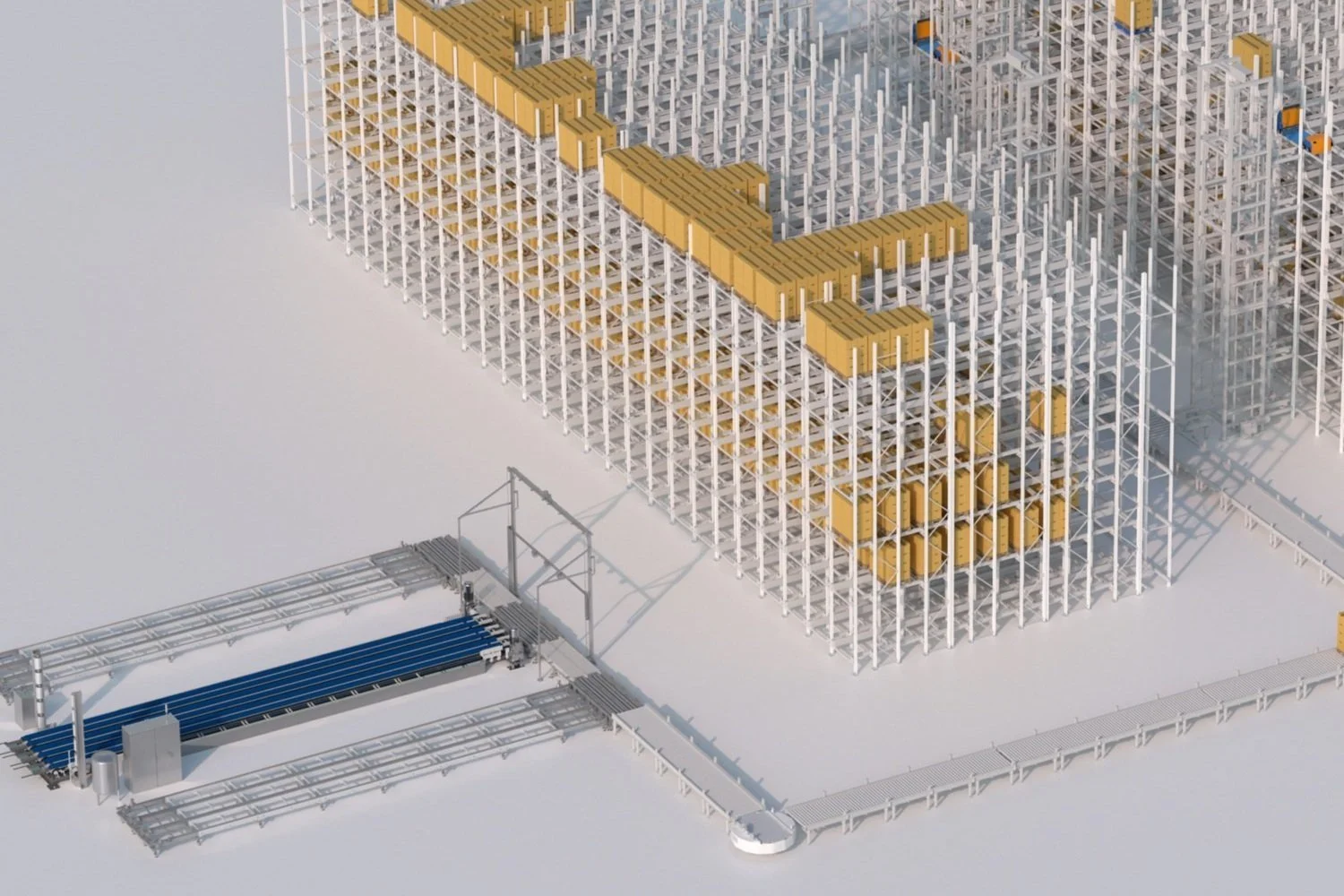
The Q-Loader is a complete conveyor-to-trailer system. Every upstream component is specified to the site, sized to the dock count and configured to the pallet requirement, including custom containers and totes engineered to the SKU profile where the load calls for it.
Buffer Zone
- Buffer capacity
- 30 NA pallets
- Chain strands
- 6 strands, type 12B-2
- Speed
- 0.66 ft/s
- Capacity per pallet
- 2,204.62 lbs
Turntable
- Turning angle
- 90 degrees
- Dimensions
- 74.8 × 74.8 in
- Buffer capacity
- 1 NA pallet
- Pallet types
- 3 pallet types
- Rollers
- Galvanised
Angle Transfer
- Dimensions
- 49.21 × 102.36 in
- Buffer capacity
- 2 NA pallets
- Pallet types
- 3 pallet types
- Q-Loader connection
- Extended chains for direct connection to the Q-Loader
- AGV interchange
- Customisable for AGV / AMR interchangeAllows the Q-Loader to hand directly to an autonomous fleet without an intermediate staging step.
Pallet Funnel
- Design
- Inclined steel or roller funnel for load guidance
- Squeezing devices
- Optional, specified by load stability requirements
Every install is engineered to the customer.
The Q-Loader is not a catalogue product. Parameters are defined in the detailed design phase and the system is built to those parameters, not adapted from a standard configuration.
Pallet type and orientation
Specified by the customer. The system is configured to your pallet dimensions, weight distribution and loading orientation.
AGV and AMR interchange
The angle transfer can be customised for direct interchange with autonomous guided vehicles and mobile robots. The Q-Loader hands off directly to an autonomous fleet without an intermediate staging step.
Safety components and fencing
Configured per order quantity and site. Safety barrier layout, light curtain coverage and emergency stop circuit topology are defined against the specific building and dock count.
Control cabinet layout
Number and location of control cabinets is determined per building, resolved in the detailed design phase against the electrical infrastructure and maintenance access requirements.
Loading bridge drive type
Pneumatic or electrical drive is selected in the detailed design phase, depending on site compressed air availability, environmental conditions and maintenance preference.
Buffer sizing
The buffer zone is sized to the customer's pallet requirement. Standard configuration accommodates 30 NA pallets; this is adjusted to match dock count and upstream flow rate.
Pallet block arrangement on the Q-Loader platform. Block pattern, pallet orientation and number of rows are specified in the detailed design phase against the customer's load requirement.
Industrial-grade, top to bottom.
- PLC control with distributed IO Centralised logic with distributed field IO. Standard industrial architecture suited to the dock environment.
- Inverters on every conveyor Soft start and stop on all conveyor drives. Reduces mechanical shock, extends component life and enables precise speed control.
- Failsafe PLC safety system Tied to emergency stops, safety barriers and light curtains, with reset stations on each control cabinet. Fully independent from the main PLC.
- HMI visualisation Graphical and textual status by area, fault display, operating mode switching and manual control. Interfaced to the MFC system.
- Secure VPN remote diagnostics Encrypted remote access for diagnostics and support, reducing response time for fault diagnosis without requiring on-site access.
| Component | Standard supplier | Alternatives |
|---|---|---|
| PLC controller | Siemens | Omron, Mitsubishi, Beckhoff |
| HMI panel | Siemens | Proface, Turck, Weintek |
| Inverters | SEW | Lenze, LS, Nord, Siemens, Danfoss |
| Safety controller | Siemens | SICK, Turck, PILZ |
| Safety photobarriers & sensors | SICK | Turck, Leuze, Keyence |
| Code scanners | SICK | Datalogic, Cognex |
| Gearmotors | SEW / NORD | Lenze, Siemens |
| Pneumatics | FESTO | SMC |
| Bearings | SKF | FAG, NSK |
| Control cabinets | Schneider Electric | Rittal, Sarel, Eldon |
From delivery to warranty, covered.
- Free delivery Includes unloading, internal transport to the installation point and packaging disposal.
- Mechanical and electrical installation Equipment provided by us and WDX Group. Installation is carried out to agreed parameters and verified before sign-off.
- Technical acceptance Against agreed parameters and a defined acceptance scenario. Acceptance is not completed until the system performs to specification.
- On-the-job operator training Scoped to the customer's operating team. Training is carried out on the installed system against the actual site workflow.
- 12-month warranty From installation acceptance. Covers mechanical and electrical systems.
- Preventative maintenance plan Optional yearly plan covering spare parts and servicing, available after the warranty ends.
- CE certificate and declaration of conformity
- Full design and technical risk (DTR) documentation
- Safety case documentation
- Electrical schematics and PLC source code
- Maintenance and spare parts manuals
- Operator training materials
Where Q-Loader wins: dedicated lanes, repeatable patterns.
Where the Q-Loader performs at its best
Q-Loader is purpose-built for high-volume, repeatable, dedicated inbound and outbound lanes with consistent pallet patterns. When raw throughput per dock is the deciding metric and the workflow is fixed, the Q-Loader ATLS delivers the highest return of any dock automation system in this category.
- Dedicated, high-volume loading and unloading lanes
- Consistent, repeatable pallet patterns
- Facilities where dock count drives capital cost
- Operations targeting sub-24-month payback on dock automation
Where you need flexibility instead
When the workflow has to flex, with changing dock assignments, mixed product mixes, seasonal volume swings, or the full journey from trailer through racking to high-bay storage, a flexible autonomous forklift fleet is the right tool.
VisionNav autonomous forklifts handle every part of the pallet journey that the Q-Loader is not designed for. The two systems are complementary halves of one complete intralogistics portfolio, and  integrates both.
Bringing Q-Loader to North America.
The Q-Loader ATLS is a WDX Group technology. Manufacturing Solutions is the authorised US distribution and integration partner, handling site assessment, system installation, commissioning, training and ongoing service for Q-Loader deployments across North America.
Don't budget this as capital expenditure.
We own the fleet. You pay a monthly operating expense priced below the payroll it replaces, with zero capital request and zero balance-sheet impact. Payments begin only when the system hits your agreed throughput threshold.
No capital request attached
Put a five-minute trailer cycle on your dock.
Talk to an engineer about site requirements, expected throughput and the payback timeline.
Questions we get every week
What buyers ask before an automated truck loading project gets funded.